Readability Formulas & Speech Rate: A Linguist's Guide
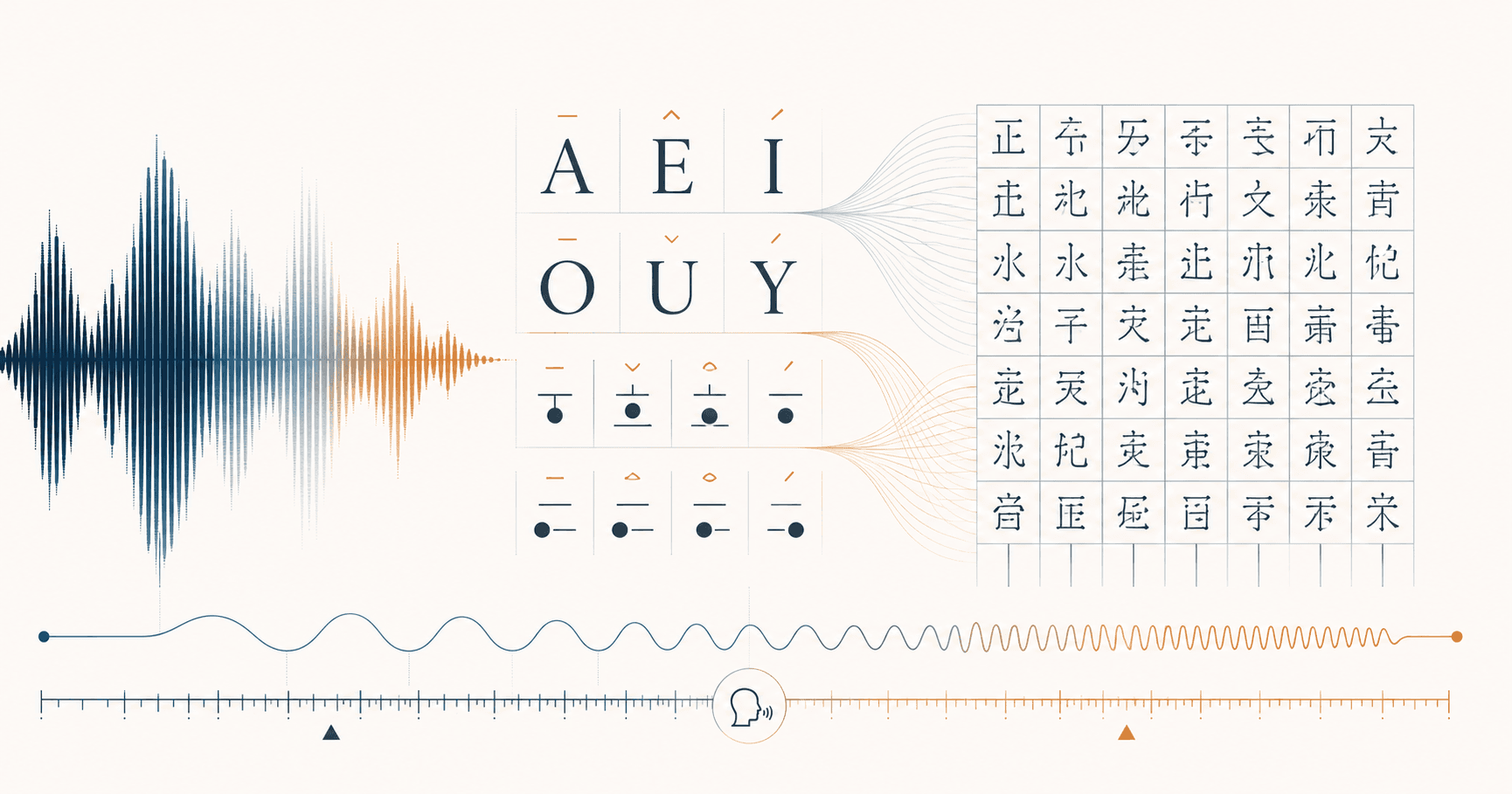
Every editorial decision from a headline's grade level to a subtitle's exposure time is governed by measurable linguistic constants. Yet most "readability checkers" treat these constants as black boxes, returning a single score without exposing the arithmetic underneath. This analysis reconstructs the actual algorithms: the syllable-counting heuristics that trip up even professional tools, the words-per-minute (WPM) variance across dialects and delivery contexts, and the character-density asymmetry between CJK and Latin scripts that silently breaks subtitle timing when formulas built for English are applied to Mandarin or Japanese source text.
The Architecture of Readability Formulas
Readability indexes are regression models trained decades ago on graded reading passages. They compress a text into two surface statistics sentence length and syllable-to-word ratio and map that pair onto a predicted grade level. The elegance of the formula hides real fragility in how "syllables" get counted.
The Flesch-Kincaid Grade Level Formula
The Flesch-Kincaid Grade Level (FKGL) is computed as:
The sibling metric, Flesch Reading Ease, inverts the scale so higher numbers mean easier text:
Two variables drive both equations: sentence length (a proxy for syntactic load) and syllable-to-word ratio (a proxy for lexical density and morphological complexity). A text with short sentences but heavily Latinate, polysyllabic vocabulary common in legal or medical writing can still register a high grade level despite "simple" grammar, because the formula weights syllable density more heavily than clause structure. For a working implementation of this exact regression against your own copy, the Flesch-Kincaid Reading Level tool applies both formulas simultaneously and flags where they diverge.
Syllable Counting: The Edge Cases That Break Automated Scoring
Every popular readability library from Python's textstat
to browser-based JS scorers approximates syllable counts with vowel-cluster heuristics rather than true
phonemic parsing. This produces systematic errors:
- Silent terminal "e": "hope" is one syllable, but naive vowel-group counting sees two clusters (o, e) unless the algorithm explicitly strips a trailing silent "e" before counting.
- Consecutive vowel ambiguity (diphthong vs. hiatus): "boat" (one syllable, diphthong) versus "react" (two syllables, hiatus) look identical to a regex that simply counts vowel groups.
- "-le" endings after a consonant: "table," "little," and "cable" each carry a syllabic "l" that vowel-counting misses entirely, undercounting by one.
- Compound and hyphenated words: "well-being" or "co-founder" are frequently tokenized as single words but phonetically contain two independent syllabic stress groups that must be summed, not treated as one lexical unit.
- Numerals, acronyms, and abbreviations: "NASA" is pronounced as two syllables (a word), while "FBI" is pronounced as three separate letter-names a distinction no character-based heuristic resolves without a pronunciation dictionary lookup (e.g., CMUdict).
Because these edge cases compound across a full document, manually auditing syllable-to-word ratio on anything beyond a paragraph is impractical; a dedicated Script Character ↔ Word Counter that also reconciles character count against word and syllable count is the only reliable way to catch systematic under- or over-counting before it skews a published grade-level claim.
Speech Rate Dynamics Across Delivery Contexts and Dialects
Words-per-minute is not a fixed constant it is a distribution shaped by genre, register, and phonological structure of the language being spoken. Treating "150 WPM" as a universal average, as many teleprompter and subtitle tools do, produces measurable timing errors once content shifts context.
Baseline WPM by Context
| Delivery Context | Typical WPM Range | Governing Constraint |
|---|---|---|
| Casual conversation | 120–150 | Cognitive planning pauses, turn-taking |
| Public speaking / keynote | 100–130 | Rhetorical pacing, audience comprehension |
| Audiobook narration | 150–160 | Sustained listener retention over hours |
| Broadcast news | 150–190 | Airtime economy, teleprompter scripting |
| Auctioneer / fast-patter speech | 250–400 | Filler-syllable chanting, formulaic phrasing |
Dialect and Phonological Variance
Speech rate also varies by the rhythmic typology of the language itself. Stress-timed languages such as General American and British Received Pronunciation compress unstressed syllables, producing more variable inter-syllable duration but comparable overall WPM. Syllable-timed languages like Spanish or French give each syllable roughly equal duration, which raises the raw syllables-per-second count even when perceived speech rate feels similar to a listener. Mora-timed languages such as Japanese further subdivide timing at the mora level rather than the syllable, meaning a WPM figure calculated for English cannot be transposed onto Japanese script without first converting the unit of rhythm. Regional dialect studies also show measurable divergence Scottish English and Southern American English registers both trend toward slower articulation rates than Standard American broadcast English, independent of vocabulary complexity. For scripts that must hit a target run-time narration, ad reads or video voiceover the Speech Rate (WPM ↔ Pages) converter lets you calibrate against the specific delivery context rather than a generic average.
Character Density: CJK Scripts vs. Latin Alphabets
Word-count-based metrics collapse entirely when applied to Chinese, Japanese, or Korean text, because those scripts encode meaning at the character level rather than through whitespace-delimited words.
Information Density Per Character
A single Chinese hanzi typically corresponds to one morpheme and carries roughly the semantic payload of 1.5–2 English words; a four-character Chinese idiom (chengyu) can compress an entire English sentence. Japanese complicates this further by mixing three scripts in one line kanji (logographic, high density), hiragana (syllabic, grammatical function), and katakana (syllabic, loanwords) so information density fluctuates within a single sentence depending on script-switching frequency. This is why "words per minute" is meaningless for CJK content; the correct unit is characters per second (CPS) or characters per minute (CPM).
CPS Constraints in Subtitling
Professional subtitling standards set different CPS ceilings by script precisely because of this density gap. Latin-script subtitles typically cap around 15–17 characters per second for comfortable adult reading speed. Chinese subtitle guidelines cap lower in raw character count often 12–15 characters per second not because Chinese readers process slower, but because each character already carries the informational weight of multiple Latin-script words, so the same semantic throughput is reached at a lower character rate. Applying a Latin CPS ceiling directly to CJK captioning under-times the display duration and produces subtitles that flash by unread; applying a CJK ceiling to Latin text over-times it and creates dead air. Cross-script localization work should always run each language's captions through a Subtitle Timing & Readability check independently rather than reusing one script's timing table across the whole project.
Structured Copy-Editing Benchmarks
Editorial teams working across content types need target ranges, not a single universal grade level. The table below reflects commonly cited industry benchmarks for U.S. English audiences.
| Content Type | Target FKGL | Target Reading Ease | Sentence Length Guidance |
|---|---|---|---|
| General news/blog copy | 7–8 | 60–70 | 15–20 words/sentence |
| Marketing/landing pages | 5–7 | 65–80 | 10–16 words/sentence |
| Technical documentation | 9–11 | 40–55 | 18–24 words/sentence |
| Legal/regulatory text | 12–14+ | 10–30 | 25+ words/sentence |
| Children's/YA content | 3–5 | 80–90 | 8–12 words/sentence |
Lexical density the ratio of content words (nouns, verbs, adjectives, adverbs) to total words is a useful secondary check alongside grade level. Text above roughly 55% lexical density tends to read as dense or academic regardless of sentence length, since function words (articles, conjunctions, prepositions) are what give a reader's working memory room to process each clause.
Frequently Asked Questions
Why do two readability tools give different grade levels for the same text? ▾
Differences almost always trace back to syllable-counting heuristics, not the formula itself. Tools that strip silent "e" endings or resolve syllabic "-le" clusters correctly will report lower syllable counts and therefore a lower grade level than tools using a naive vowel-group regex.
Is 150 words per minute a reliable average for every language? ▾
No. That figure is derived from English speech studies. Syllable-timed and mora-timed languages require their own baselines, and even within English, delivery context (broadcast vs. conversational vs. auctioneer speech) shifts the average by more than 100 WPM.
Why can't I use the same subtitle CPS limit for English and Chinese? ▾
Because a single Chinese character typically carries the semantic weight of more than one English word. Applying an English CPS ceiling to Chinese captions under-displays them; the correct approach is to set an independent, lower character-per-second ceiling calibrated to that script's information density.
What is lexical density and why does it matter alongside grade level? ▾
Lexical density is the proportion of content words (nouns, verbs, adjectives, adverbs) relative to total words. It flags dense, information-heavy text even when sentence length is short, catching cases a grade-level score alone would miss.