Equine Dose Scaling, DMI & Saddle Fit: A Clinical Guide
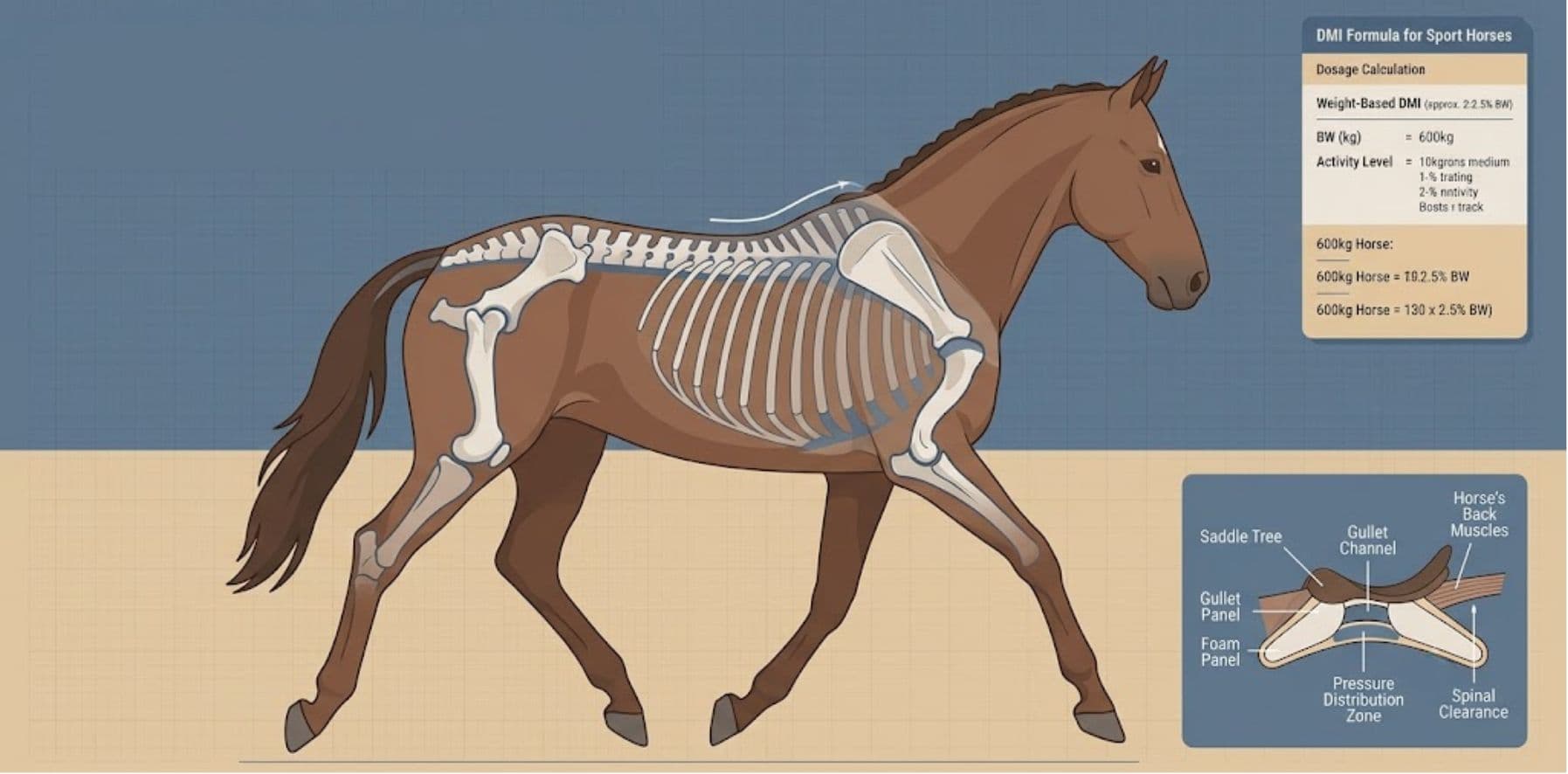
Equine practice sits at the intersection of pharmacology, biomechanics, and applied nutrition a discipline where a single miscalculated variable, whether in a drug volume, a dry matter intake (DMI) ration, or a saddle-tree width, can compromise soundness, welfare, or performance. This guide walks through the quantitative frameworks that separate rule-of-thumb estimation from defensible clinical and husbandry practice: allometric dose scaling, metabolic body surface area, wither clearance geometry, and carcass dressing percentage algebra. Each section is written for the practitioner who needs the formula and the physiology behind it.
Equine Pharmacokinetics and Allometric Dose Scaling
Horses are not simply "large dogs" from a pharmacokinetic standpoint. Hepatic microsomal enzyme activity, gastrointestinal transit time (roughly 30–45 hours in a hindgut fermenter versus 6–8 hours in a monogastric carnivore), and plasma protein binding all diverge sharply between species, which is why body-weight-only extrapolation from small-animal or human dosing charts is clinically unreliable.
Clark's Rule and Its Equine Limitations
Clark's Rule originally a pediatric linear-scaling formula expresses dose as:
Linear scaling assumes drug clearance rises proportionally with body mass, which holds reasonably well for drugs with a wide therapeutic index and simple renal clearance. It breaks down for agents metabolized via cytochrome P450 pathways, where clearance correlates more closely with metabolic rate than raw mass the basis for allometric (exponential) scaling.
Metabolic Body Size Scaling (Kleiber's Law)
For drugs whose clearance tracks basal metabolic rate many antimicrobials, NSAIDs, and sedatives the allometric exponent of 0.75 (Kleiber's Law) produces a more physiologically accurate dose:
Dose (mg) = Dose Rate (mg/kg⁰·⁷⁵) × Metabolic Body Weight
For a 500 kg adult Warmblood, metabolic body weight = 500^0.75 ≈ 105.7 kg⁰·⁷⁵ meaningfully lower than the 500 kg linear figure, which is why straight mg/kg extrapolation from a 25 kg foal or a human reference dose can produce clinically significant over-dosing in draft-type breeds. Because inter-species allometric exponents, protein-binding percentages, and hepatic clearance rates vary so widely, practitioners should never freehand a cross-species conversion. Running the patient's exact weight and target drug class through a dedicated Species-Specific Drug Dosing calculator removes the manual exponentiation error that hand-calculating kg⁰·⁷⁵ under field conditions commonly introduces.
Dry Matter Intake and Nutritional Bioenergetics
Equine dietary planning is governed by dry matter intake (DMI) as a percentage of body weight, not gross feed weight, critical, since hay and pasture forage carry 10–15% residual moisture that inflates as-fed tonnage calculations.
Baseline DMI Equation
Maintenance-level idle horses sit near the 1.5–2.0% factor; heavily exercising or lactating mares can require 2.5–3.0% of body weight in dry matter to meet digestible energy (DE) demand, expressed in Mcal/day. Body condition scoring (Henneke 1–9 scale) should be cross-checked against calculated DMI every 30 days, since forage quality (NDF/ADF fiber fractions) shifts the effective energy yield per kilogram independent of intake volume. Because ration formulation also depends on metabolic body surface area for maintenance energy requirement (MER = 97 × BW⁰·⁷⁵ kcal/day, per NRC guidelines), forage-to-concentrate ratios should be recalculated rather than assumed constant across a horse's life stages. A structured Animal Feed & Dry Matter Calculator is the fastest way to reconcile as-fed hay weight, moisture percentage, and target DMI without manual unit conversion errors creeping into the ration sheet.
Saddle Fit, Wither Clearance, and Gait Mechanics
Saddle fit is a biomechanical intervention, not a cosmetic one. Poor tree-to-wither congruity alters thoracic sling function, the muscular system (serratus ventralis, trapezius, rhomboideus) that suspends the ribcage between the forelimbs without a bony strut and downstream effects on equine gait mechanics are measurable in stride length and hindlimb impulsion.
Wither Clearance Angle
Static clearance at the withers should allow 2–3 finger-widths (roughly 4–6 cm) of daylight under the pommel with a rider mounted, but static clearance alone is insufficient panel angle must match the thoracic vertebral spinous process trajectory (T3–T9) within approximately 5–10° to avoid bridging or point-loading. Dynamic assessment under saddle-pad pressure mapping is the current clinical standard, since static fit frequently fails once the scapula rotates through its full protraction-retraction arc at trot.
Skeletal Alignment and Load Distribution
Ideal panel bearing surface distributes rider and tack load across the epaxial musculature lateral to the spinous processes never directly on them, extending roughly from behind the scapular cartilage to the last rib (T18), respecting the "float zone" over the lumbar transverse processes where there is minimal muscular padding to absorb point pressure.
Carcass Dressing Percentage and Yield Algebra
For farm managers overseeing mixed livestock operations, carcass yield calculation follows a standardized dressing percentage formula used across equine, bovine, and other livestock carcass evaluation:
Typical dressing percentages range from 50–63% depending on species, breed muscling, and gut fill at slaughter live weight itself should be recorded after a 12–24 hour feed withdrawal to normalize gastrointestinal fill variance, which can otherwise skew yield calculations by several percentage points. Because feed withdrawal protocols, breed-specific muscling coefficients, and moisture-loss shrinkage all interact non-linearly, manual arithmetic is a common source of yield-reporting error on mixed-species operations. The Livestock Live Weight ↔ Carcass Yield tool standardizes this conversion across species-specific dressing percentage ranges.
Comparative Veterinary Aging and Cross-Species Context
Practitioners managing mixed operations an equine barn alongside farm dogs often need to translate physiological age across species when coordinating geriatric care protocols, since metabolic scaling exponents and expected lifespan curves differ meaningfully between hindgut fermenters and carnivorous companion species. For quick cross-species reference during herd or kennel health planning, the Dog Age ↔ Human Age Equivalent converter is a useful adjunct when coordinating comparative geriatric benchmarks across an operation's animals.
Frequently Asked Questions
Why does linear (Clark's Rule) dosing overestimate volumes in large-breed horses?
Because drug clearance for many compound classes scales with metabolic rate (body weight⁰·⁷⁵), not raw body mass. Linear scaling assumes a 1:1 relationship, which increasingly overstates required dose as body weight rises past a few hundred kilograms a gap that widens further in draft breeds exceeding 800 kg.
What DMI percentage should I use for a lactating broodmare?
Lactating mares typically require 2.5–3.0% of body weight in dry matter daily to meet elevated digestible energy demand, compared with 1.5–2.0% for an idle maintenance horse the exact figure depends on forage quality and stage of lactation.
How much wither clearance is considered clinically acceptable?
A static clearance of 2–3 finger-widths (approximately 4–6 cm) under a mounted rider is the standard baseline, but dynamic clearance through the full gait cycle assessed via pressure mapping is the more clinically reliable metric.
Why does gut fill matter when calculating carcass dressing percentage?
Live weight recorded without a feed withdrawal period includes variable gastrointestinal contents, which can inflate the denominator in the dressing percentage formula and understate true yield by several percentage points.