Exposure Physics: Hyperfocal, CoC & ND Math Guide
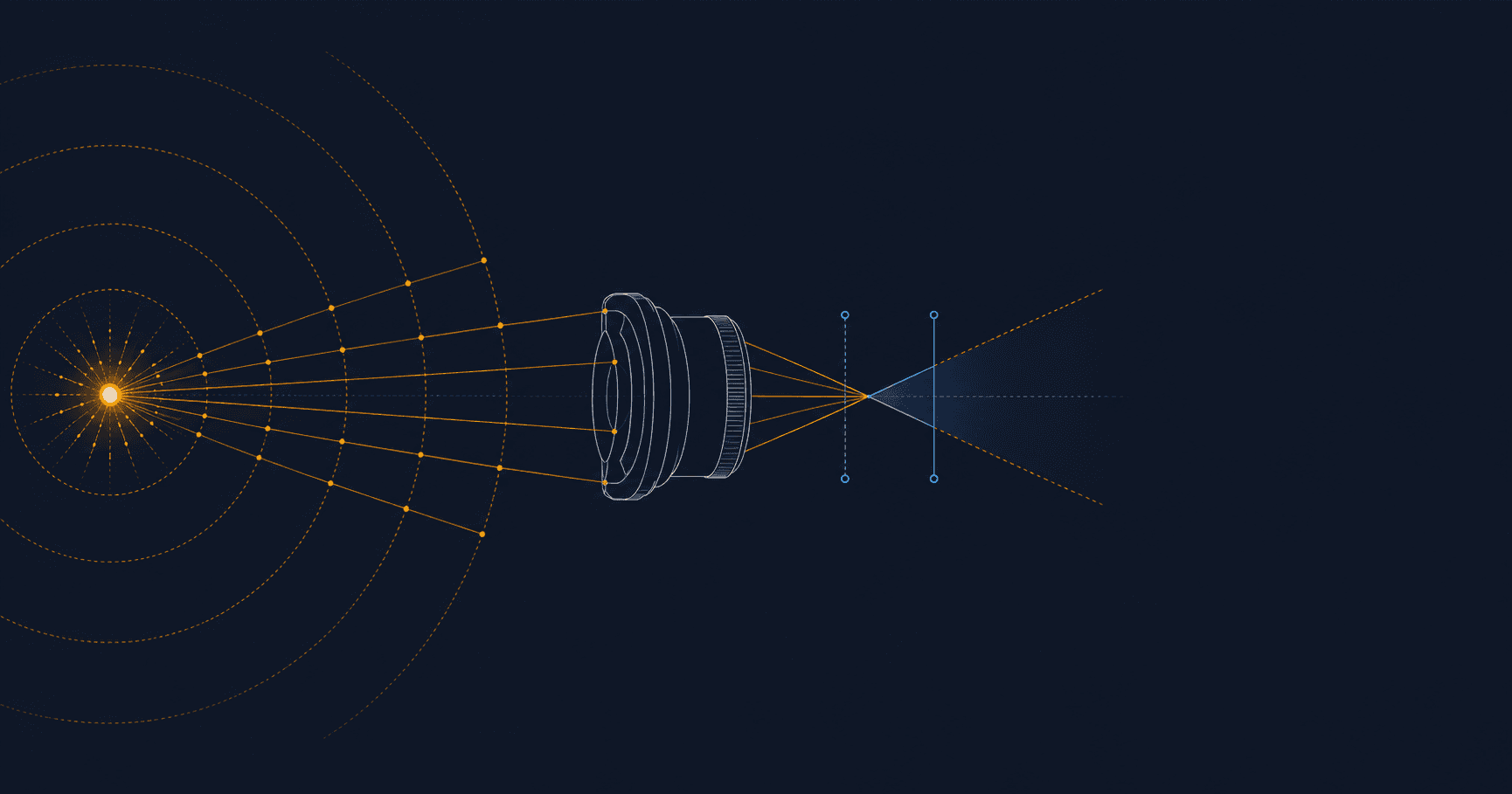
Every frame a cinematographer or photographer captures is the resolution of three coupled physical systems: photon flux governed by the inverse-square law, geometric optics defining what "in focus" actually means at the pixel level, and the sensor's electronic response to a finite quantity of light. Most explainers treat these as three separate settings dials. They are not. They are three variables in the same radiometric equation, and understanding the math that links them is what separates an operator who guesses from an operator who calculates.
The Exposure Equation: Beyond the Triangle
The conventional "exposure triangle" aperture, shutter speed, ISO is a pedagogical simplification of a single photometric identity. The formal relationship is expressed through the Exposure Value (EV) equation:
where N is the relative aperture (f-number) and t is exposure time in seconds. This is the calibration-independent half of the equation. To tie it to actual scene luminance, the full radiometric form is:
where L is scene luminance in cd/m², S is ISO sensitivity, and K is the reflected-light meter calibration constant (typically 12.5 for ISO-standard meters). Every "stop" you move doubling or halving aperture area, shutter duration, or sensor gain is a base-2 logarithmic step in this identity, which is why exposure math is fundamentally binary-logarithmic rather than linear. For a working reference on how these three variables trade off in real camera bodies, the Exposure Triangle & F-Stop tool converts between stop-equivalent values across all three axes simultaneously.
T-stops (transmission stops) refine this further by accounting for the fact that no lens transmits 100% of incident light. The T-stop is derived from the f-stop via the lens's measured transmission factor:
where Tr is the fractional transmittance of the optical assembly (typically 0.80–0.95 for coated cine glass, lower for older or uncoated designs). A lens marked f/2.8 with 85% transmission actually meters at approximately T/3.0 a discrepancy that matters enormously in multi-camera productions where lens-to-lens exposure matching is done by T-stop, not f-stop.
The Inverse-Square Law and Luminous Intensity Falloff
Illuminance from a point source does not fall off linearly with distance it falls off with the square of distance. This is the inverse-square law, and it is the single most important lighting equation in professional cinematography and studio photography:
where E is illuminance at the subject (in lux), I is luminous intensity of the source (in candela), and d is distance in meters. The practical consequence: doubling the distance between a key light and subject reduces illuminance to one-quarter, not one-half a 2-stop light loss, not 1-stop. This is why lighting ratios computed for a fill light at 3 meters break down catastrophically if the light is moved to 4.5 meters without recalculating.
For two sources at different distances, the relative illuminance ratio simplifies to:
Gaffers use this identity constantly when converting a lighting diagram measured on a tape line into stop-accurate ratios for the DP a 1:2 key-to-fill distance ratio yields a 4:1 (2-stop) intensity ratio, not a 2:1 (1-stop) ratio as intuition often suggests.
Circle of Confusion: The Geometric Definition of "Sharp"
"In focus" is not a binary state it is a threshold defined by the circle of confusion (CoC), the maximum diameter a defocused point of light can occupy on the sensor before the human eye perceives it as blurred rather than as a point. The CoC threshold is derived from sensor diagonal and expected viewing conditions, typically:
where d is the sensor's diagonal measurement. This single constant is why a full-frame sensor (43.3mm diagonal, c ≈ 0.029mm) and a Super 35 sensor (approx. 28mm diagonal, c ≈ 0.019mm) produce visibly different depth-of-field characteristics at identical f-stops and framing the smaller circle of confusion tolerance on cropped sensors makes focus fall off more critically, not less, contrary to the common misconception that crop sensors are more forgiving.
From the CoC constant, near and far depth-of-field limits are calculated as:
D_far = (H · s) / (H − (s − f))
where H is the hyperfocal distance, s is the focus distance, and f is the focal length (all in consistent units). When s − f exceeds H, the far-limit denominator goes negative, indicating depth of field extends to infinity. Manually resolving this system for every focus pull is impractical on set the Depth of Field (DoF) Calculator solves both limits directly from sensor format, focal length, aperture, and focus distance.
Hyperfocal Distance: The Geometric Limit of Acceptable Sharpness
Hyperfocal distance is the focus distance at which depth of field extends from half that distance to optical infinity the point past which further increases in focus distance yield no additional far-field sharpness. It is derived from the same CoC constant:
where f is focal length, N is f-number, and c is the circle of confusion. The "+f" term is frequently dropped in simplified formulas, but at wide focal lengths and large apertures it introduces meaningful error (a 24mm lens at f/1.4 sees a ~5% shift in H if the term is omitted). The hyperfocal near-limit the closest point still rendered acceptably sharp when focused at H is simply:
This is the governing math behind fixed-focus documentary and street photography setups, and behind "deep focus" cinematography where a director wants foreground and background simultaneously legible without a focus pull. Rather than solving the quadratic-adjacent formula above by hand for every lens/aperture combination on a kit list, the Hyperfocal Distance Calculator returns both H and the near limit instantly for any sensor format.
Neutral Density Filtration: Transmission Factor Mathematics
Neutral density (ND) filters attenuate incident light without altering color temperature (in theory real filters have non-zero spectral deviation, which is why "true neutral" glass commands a premium). Attenuation is expressed via optical density, where each 0.3 increment in density corresponds to one full stop:
An ND 0.9 filter (D = 0.9) yields 3 stops of attenuation, a filter factor of 8×, and a transmittance of 12.5% meaning shutter speed or aperture must compensate by exactly 3 stops to maintain equivalent exposure. Variable ND filters, common in run-and-gun cinematography, are two stacked polarizing elements whose relative rotation angle θ produces a continuously variable transmittance approximated by Malus's Law:
This is also precisely why variable ND filters produce an "X-pattern" color shift or vignette artifact at their maximum-attenuation extreme on wide lenses the polarization angle at near-total attenuation interacts non-uniformly with off-axis light rays. For converting between optical density, stops, and filter factor across the standard ND range used in cine and still production, use the ND Filter Stops Converter.
Sensor Crop Factor and Effective Focal Length
Crop factor (CF) is the ratio of a reference sensor diagonal (typically 35mm full-frame, 43.3mm) to the diagonal of the sensor in use:
Critically, crop factor changes angle of view and, through the CoC term discussed above, depth-of-field rendering but it does not change the actual focal length, aperture transmission, or the physical inverse-square light falloff at the subject. A 50mm f/2 lens is still a 50mm f/2 lens optically; only the recorded field of view and the effective circle of confusion threshold change with sensor size. Conflating "equivalent focal length" with an actual optical transformation is one of the most persistent errors in crop-factor discourse.
Applied Workflow: Resolving All Four Systems on Set
Consider a practical scenario: a DP is shooting Super 35 (28mm diagonal) at 35mm focal length, wants deep focus from 2m to infinity in overcast daylight, and needs to hold a specific shutter angle for motion characteristics.
- Compute c from sensor diagonal (≈0.019mm at the 1500 divisor).
- Solve H = (f² / (N·c)) + f for candidate apertures until D_near(H) = H/2 falls at or below 2m.
- Verify the resulting T-stop against incident meter reading using EV = log₂(N²/t) to derive required shutter time.
- If ambient EV exceeds what the target shutter angle and ISO can absorb, insert ND filtration calculated in stops, not filter-factor multiples, to avoid compounding rounding error.
Each step above is a direct application of one of the four equations covered in this guide none of them can be reasoned through by "feel" with the precision a client-facing production demands, which is exactly why these calculations are standardized into dedicated tools rather than left to mental math on a lockup day.
Frequently Asked Questions
Does a smaller circle of confusion mean more forgiving depth of field?
No, a smaller CoC tolerance (typical of smaller sensors) means focus errors become visible sooner, not later. Smaller sensors have less depth-of-field forgiveness per unit of focus error, even though their absolute depth-of-field range at matched framing is often deeper due to shorter focal lengths required for equivalent field of view.
Why do T-stops differ from f-stops on the same lens?
F-stops are a purely geometric ratio of focal length to aperture diameter and assume perfect transmission. T-stops are measured empirically and account for actual light loss through glass elements, coatings, and internal reflections, which is why cinema lenses are rated in T-stops for exposure-critical multi-camera matching.
Does doubling the distance to a light source really cost two stops?
Yes. Under the inverse-square law, illuminance falls with the square of distance, so doubling distance reduces light to one-quarter of its original intensity a 2-stop reduction, not a 1-stop reduction as linear intuition suggests.
Is crop factor an actual optical change to the lens?
No. Crop factor only changes the recorded angle of view and the effective circle-of-confusion threshold for depth-of-field calculations. The lens's true focal length, aperture, and light transmission remain physically unchanged regardless of sensor size.