Ammonia Toxicity, Gas Laws & MOD: Diving Physics Guide
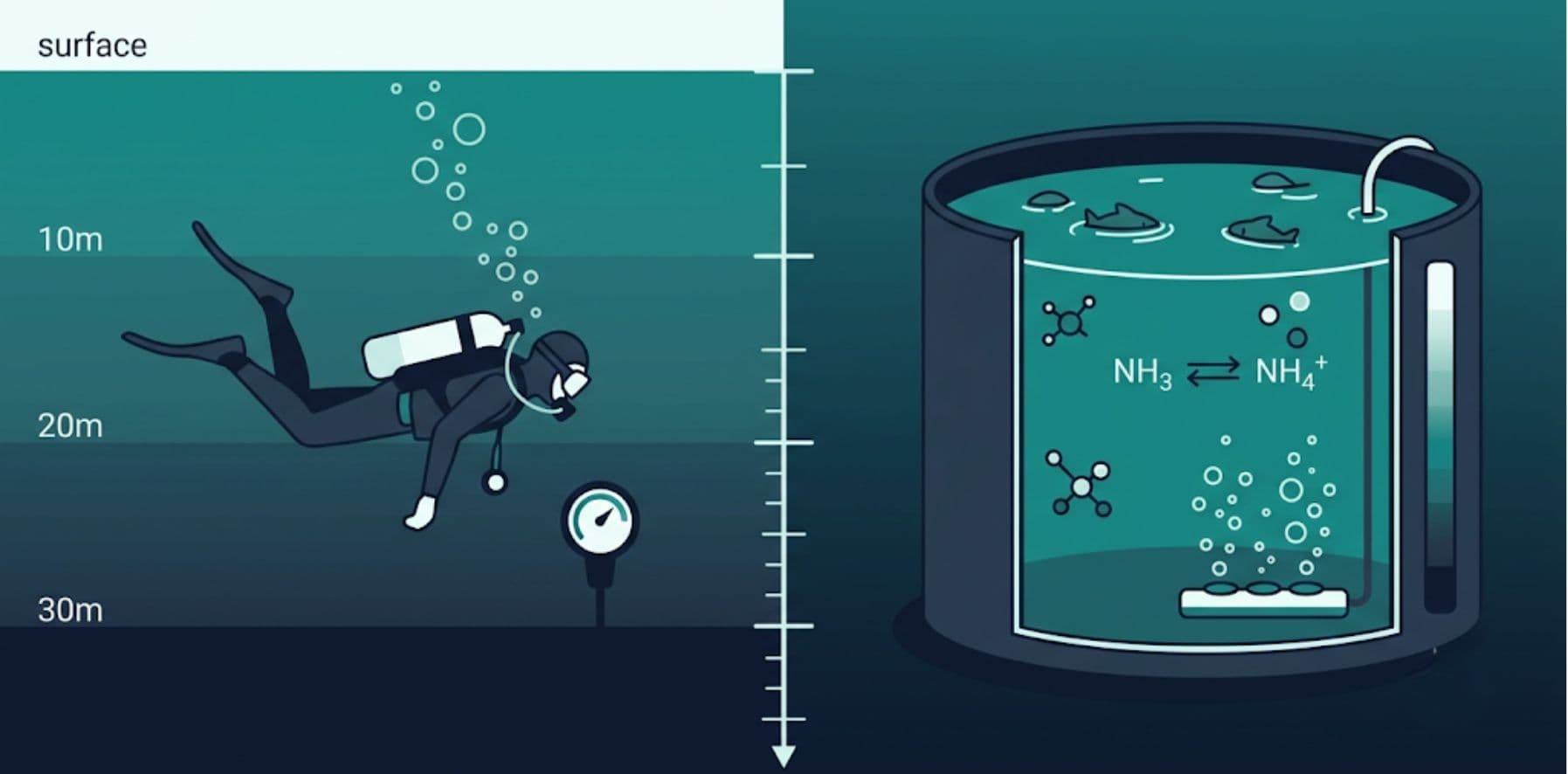
Every closed-loop aquaculture system and every staged decompression profile is, at its core, an exercise in applied physical chemistry. The same partial-pressure mathematics that governs whether a fish's gill epithelium is bathed in a lethal concentration of un-ionized ammonia also governs whether a technical diver's blood nitrogen load will produce decompression sickness on ascent. This piece works through the governing equations Dalton's Law, Henry's Law, the ammonia dissociation equilibrium, and the hydrostatic pressure gradient with the level of rigor required for production system design and dive-team safety documentation.
Hydrostatic Pressure Gradients and the Physics of Depth
Water is roughly 800 times denser than air, so hydrostatic pressure accumulates far faster with depth than atmospheric pressure does with altitude. In seawater, pressure increases by approximately 1 atmosphere (atm equivalently 1.0 bar or 100 kPa for every 10 meters of saltwater (msw), owing to the higher density imparted by dissolved salts. Freshwater systems, lacking that dissolved-solid mass, require roughly 10.06 m to add the same 1 atm increment. The absolute pressure (P_abs) experienced by an organism or a diver at depth d is:
This gradient is not a peripheral detail it is the independent variable that drives every downstream gas-law calculation in both a recirculating aquaculture tank's aeration column and a diver's tissue-loading model. A 3-meter production tank column and a 30-meter technical dive both live on the same curve; only the magnitude of the resulting partial pressures differs.
Dalton's Law and Partial Pressures
Dalton's Law states that the total pressure exerted by a gas mixture equals the sum of the partial pressures of its constituent gases:
For a diver, the partial pressure of oxygen (ppO2) at any depth is calculated as the fraction of oxygen in the breathing gas (FO2) multiplied by absolute pressure:
Oxygen toxicity risk (the CNS "oxygen clock") becomes a limiting factor once ppO2 exceeds roughly 1.4–1.6 atm, which is precisely why enriched-air nitrox and trimix blends must be depth-restricted. This is the physiological basis of Maximum Operating Depth (MOD) planning, and it is the same reason technical teams should always confirm their Gas mix against the dive profile before entering the water an FO2 miscalculation of even a few percentage points shifts the ceiling depth substantially.
Henry's Law and Gas Solubility
Henry's Law governs how much gas dissolves into a liquid at equilibrium, and it is the master equation behind both nitrogen tissue-loading in decompression theory and dissolved oxygen (DO) saturation in an aquaculture tank:
where k_H is the Henry's Law solubility constant (temperature- and salinity-dependent) and P_gas is the partial pressure of the gas at the water/gas interface. Two applied consequences follow directly:
- Aquaculture: DO saturation drops as water temperature and salinity rise, since k_H decreases a broodstock tank at 28°C and 35 PSU holds meaningfully less oxygen at identical ppO2 than the same tank at 18°C and 15 PSU, demanding compensatory aeration or pure-O2 injection.
- Diving physiology: Nitrogen (or helium, in trimix) dissolves into blood and tissue proportional to its partial pressure at depth. On ascent, if P_abs drops faster than the dissolved gas can off-gas through the pulmonary circulation, bubbles nucleate the mechanism underlying decompression sickness and the entire rationale for staged decompression stops.
Managing Un-Ionized Ammonia Toxicity in Closed Aquaculture Systems
Total ammonia nitrogen (TAN) in a recirculating system exists in a pH- and temperature-dependent equilibrium between two chemical species: the un-ionized, lipid-soluble, highly toxic NH3, and the ionized, comparatively benign NH4+. Because only the un-ionized fraction diffuses freely across gill membranes and disrupts ion transport and osmoregulation, tracking Ammonia toxicity requires resolving the equilibrium fraction, not simply the TAN concentration a standard test kit reports.
The Ammonia Equilibrium Equation
The dissociation reaction is:
The un-ionized fraction of TAN is derived from the Henderson–Hasselbalch relationship as a function of pH and the temperature/salinity-corrected pKa:
with pKa itself modeled empirically (Emerson et al.) as a function of absolute temperature T (Kelvin) and ionic strength:
The concentration of un-ionized ammonia is then simply the product of the measured TAN and this fraction:
The nonlinearity here is the operationally critical fact: a pH rise from 7.5 to 8.5 does not increase the toxic fraction by 1 unit of linear proportion it multiplies it roughly tenfold, because the equation is logarithmic in (pKa − pH). A biofilter that comfortably handles a TAN spike at pH 7.4 can produce an acutely lethal un-ionized ammonia concentration at pH 8.2 with the exact same TAN reading. This is why pH control, not just TAN monitoring, is the primary lever in commercial RAS (recirculating aquaculture system) design.
Practical Salinity Units and Ammonia Fraction Shifts
Salinity, expressed in Practical Salinity Units (PSU), modifies both the pKa constant and the activity coefficients of the ionic species, meaning identical TAN and pH readings yield different un-ionized fractions across a freshwater, brackish, and full-strength marine system. Designers building multi-species or transitional (freshwater-to-marine) production lines should independently verify Salinity at each stage rather than assuming a single toxicity threshold carries across the salinity gradient. As a rule of thumb, higher PSU environments shift the un-ionized fraction slightly downward relative to freshwater at matched pH and temperature, but this offset is small relative to the pH-driven effect and should never be used as a substitute for direct pH management.
Gas Mix Selection and Maximum Operating Depth
MOD Calculation Methodology
Maximum Operating Depth is the deepest point at which a given breathing gas mix keeps ppO2 below the chosen safe ceiling (commonly 1.4 atm for the working portion of a dive, 1.6 atm for decompression stops). Rearranging the Dalton's Law expression above:
For a 32% nitrox blend targeting a 1.4 atm ceiling: MOD = ((1.4 / 0.32) − 1) × 10 ≈ 33.75 msw. Every custom blend nitrox, trimix, heliox needs this calculation run explicitly before dive planning, since a generically "safe" mix at one depth becomes an oxygen-toxicity hazard at another. This is exactly the computation a properly configured Gas mix planning tool should automate for a dive team building a multi-stage decompression profile.
Tank Pressure, SAC Rate, and Dive Planning Logistics
Surface Air Consumption (SAC) rate normalizes a diver's breathing gas usage to sea-level conditions, allowing planners to project cylinder duration at any target depth. The core formula:
where P_start and P_end are cylinder pressures (bar), V_tank is cylinder water volume (liters), t is elapsed time (minutes), and P_abs is the average absolute ambient pressure over the interval. Because gas consumption scales linearly with P_abs, a diver with a 15 L/min SAC rate at the surface will consume roughly 60 L/min at 30 msw (P_abs = 4 atm) a factor planners must apply before setting turn-pressure and reserve-gas rules for a working dive. Verifying Tank pressure against remaining bottom time at depth, rather than at the surface equivalent, is the single most common omission in amateur dive planning and a non-negotiable check in commercial diving operations logs.
Salinity, Osmoregulation, and System Design
Salinity governs far more than density-driven pressure gradients it directly determines osmotic gradients across gill and skin epithelia, gas solubility coefficients under Henry's Law, and the equilibrium chemistry of ammonia and CO2 dissolution described above. Aquaculture system designers moving between hatchery (typically low PSU) and grow-out (higher PSU, often near full seawater at ~35 PSU) stages must treat Salinity as a first-class design variable one that interacts multiplicatively, not additively, with temperature, pH, and dissolved oxygen targets across the full production chain.
Frequently Asked Questions
Why does raising pH increase ammonia toxicity even if TAN stays constant?
Because the un-ionized fraction f(NH3) = 1 / (1 + 10^(pKa − pH)) is exponential in pH. A rise from pH 7.5 to 8.5 shifts the equilibrium heavily toward the toxic NH3 species even though total ammonia nitrogen hasn't changed, often producing a roughly tenfold increase in the toxic fraction.
How does Henry's Law affect dissolved oxygen targets in warm-water aquaculture?
Henry's Law solubility constants decrease as temperature rises, so warm-water systems hold less dissolved oxygen at the same ppO2 as cooler systems, requiring higher aeration rates or supplemental pure-oxygen injection to hit equivalent DO saturation targets.
What is the practical difference between MOD and no-decompression limits?
MOD is set by oxygen toxicity (ppO2 ceiling) and depends on the breathing gas's FO2. No-decompression limits are set by inert gas (nitrogen/helium) tissue loading under Henry's Law and depend on time at depth, independent of the oxygen fraction in the mix.
Does salinity meaningfully change hydrostatic pressure calculations for divers?
Yes, though modestly: seawater's higher density means roughly 10 m adds 1 atm, versus about 10.06 m in freshwater. Most dive computers default to a seawater or user-selected density setting, and using the wrong one introduces a small but compounding error over a multi-stage decompression profile.
Whether the system under design is a commercial RAS facility or a staged decompression dive plan, the underlying discipline is identical: resolve the governing equilibrium pressure, solubility, or dissociation explicitly, rather than relying on rule-of-thumb thresholds that silently assume fixed pH, temperature, or salinity conditions.